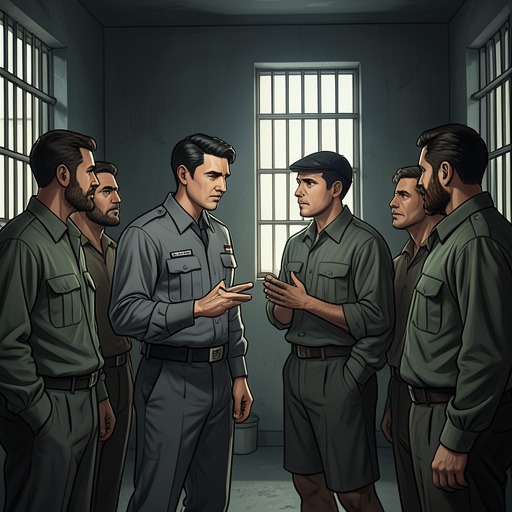
Angelus Thomsen—Roland Bullard
The Zone of InterestAngelus Thomsen—Roland Bullard is a clandestine alliance formed at the Buna-Werke between Thomsen and Captain Roland Bullard, a British prisoner whom Thomsen has watched sabotaging industrial equipment. On the last day of November, Thomsen follows Bullard into a tool cabin carrying more than a suspicion: cigarettes, a prepared signal, and knowledge of a specific act of damage. Their exchange turns that knowledge into a mutual understanding, while Bullard’s disclosure that twelve hundred others are involved reveals a resistance network far larger than the two men before him.
The Approach and Its Signals
Thomsen’s approach is deliberate. He stamps around the Yard until he spots Bullard, hangs back, and follows him into a tool cabin between the Stalags. There, Bullard has laid out the components of a dismantled welding gun on a pillowslip. The setting and the disassembled equipment establish the secrecy of the meeting, but Thomsen does not begin by confronting Bullard directly about sabotage. Instead, he offers cigarettes and identifies himself through a compressed phrase: “Players,” “Senior Services,” and “Woodbines.” The exchange makes an ordinary commodity—the cigarettes—part of the encounter’s careful language.
Bullard accepts the Woodbines warmly, remarking that they are not the most expensive but are the best. His response acknowledges Thomsen’s gesture without yet disclosing what he knows. Thomsen then invokes “Rule Britannia” and recites its words about tyrants and freedom, ending with the question, “Do we understand?” The song supplies a second signal: a public patriotic text used here to test whether the two men share a political purpose. Bullard assesses Thomsen, then inclines his head forward. The pause matters; agreement is not assumed merely because Thomsen has entered the cabin.
From Observation to Disclosure
Thomsen makes clear that he has been watching Bullard. He says he saw him bending the blades of the cooling fan in the Polimerisations-Buro and liked what he saw. The specific equipment and location make his knowledge concrete. This is not an abstract declaration of sympathy, nor simply a response to the welding-gun parts on the pillowslip: Thomsen names an act he witnessed and thereby risks showing Bullard how closely he has been observed. Bullard’s brief question—“You liked it?”—marks the moment when that disclosure is tested rather than immediately trusted.
Thomsen asks whether there are others like Bullard. The answer is startling in its scale: there are twelve hundred others. The number transforms the meeting’s apparent intimacy. Bullard is not presented as an isolated saboteur, and the damage Thomsen has witnessed belongs to a much wider effort. The evidence does not specify the organization of those people or the precise extent of their activities; what it establishes is Bullard’s claim that many others are involved, and Thomsen’s recognition that this knowledge can matter.
A Shared Rejection of the Regime
Bullard explains that, for reasons that do not concern them, he is completely fed up with the “Third Realm.” He refers to its claim to last a thousand years; Thomsen completes the thought by pushing that promised future to 2933, and Bullard agrees. Their exchange turns the regime’s grand claim of permanence into a shared joke about a future they do not intend to accept. The joking does not make their opposition casual: in the tool cabin, amid evidence of clandestine activity, it gives their common rejection a guarded form.
Bullard asks whether Thomsen needs information, offering help. Thomsen replies that he does. That brief exchange defines the practical basis of their relationship: Bullard can connect Thomsen to information, while Thomsen has approached him as someone prepared to assist the opposition. The source does not identify what information Thomsen later receives or document a particular operation carried out by the two men together. The alliance begins with an offer and an acceptance, rather than with a fully described plan.
Recognition and the Limits of the Record
Bullard lights a Woodbine and answers Thomsen’s signal with another verse from “Rule Britannia,” this time about tyrants’ attempts to bend the free. He then says, “Yes, Mr Thomsen. We understand.” The repeated phrase closes the test begun by Thomsen’s first quotation. The cigarettes, the song, and the confirmation have carried the two men from wary contact to declared understanding without requiring them to lay out a complete account of their work.
The scene presents their relationship through a small set of concrete signs: damaged fan blades, the welding gun’s components, cigarettes, and verses exchanged in a tool cabin. Its significance lies in how those signs join individual risk to collective resistance. Thomsen has seen Bullard act; Bullard has learned that Thomsen approves and can be useful; and the disclosure of twelve hundred others enlarges their meeting beyond a private compact. What the available account records is the formation of that understanding and the prospect of information-sharing, not the later course or outcome of their collaboration.